
When selecting moisture-measuring instruments, the terms ‘dew point sensor’ and ‘humidity sensor’ are often used interchangeably. In some cases, product listings and specification sheets use both terms without clarifying their distinctions or the rationale for choosing one over the other.
However, these terms do not refer to the same measurement. Selecting the wrong sensor for an application can lead to inaccurate readings, condensation damage, product spoilage, or increased operational costs in compressed air systems. Therefore, it is essential to understand what each sensor measures, its operational principles, differences in real-world performance, and suitability for specific use cases before integrating them into a process line.
This distinction extends beyond terminology. Engineers, plant managers, and procurement teams frequently specify the incorrect instrument because ‘humidity’ is the default term, even when dew point data is required. Clarifying these differences is therefore necessary.
What Does a Humidity Sensor Measure?
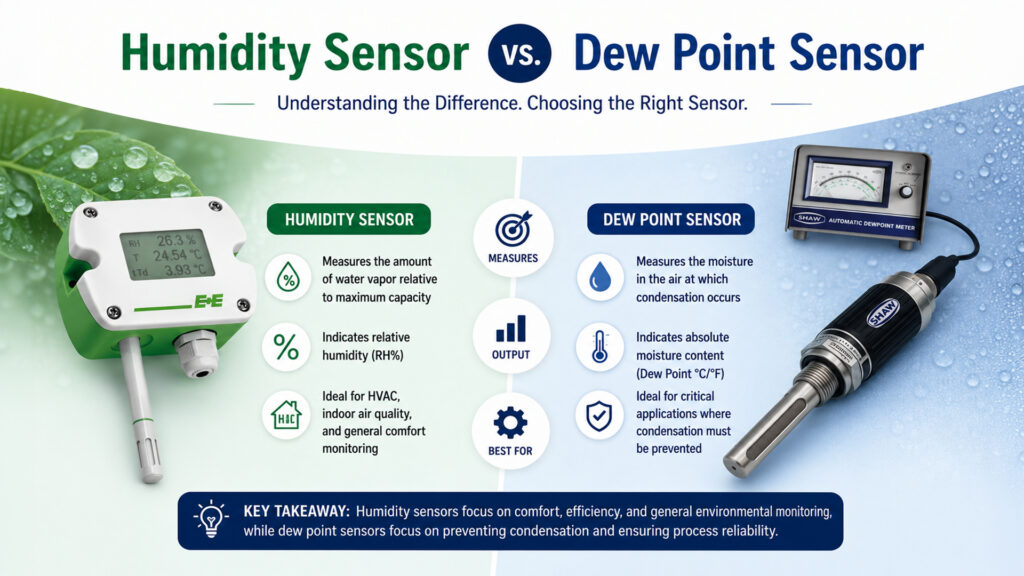
A humidity sensor measures relative humidity (RH), the amount of water vapor in the air relative to the maximum amount it can hold at that temperature, expressed as a percentage.
A common source of confusion is that relative humidity is entirely temperature-dependent. For example, air at 25°C with a specific moisture content may register 50% RH. If the temperature decreases to 10°C while the actual moisture content remains unchanged, the RH reading increases significantly. This occurs because relative humidity compares the current moisture content to the maximum possible at a given temperature, rather than measuring the absolute quantity of water vapor.
Most contemporary humidity sensors utilize either capacitive or resistive technologies. Capacitive sensors employ a thin polymer film that absorbs and releases water vapor, resulting in measurable changes in dielectric properties and capacitance. Resistive sensors, in contrast, detect changes in the electrical resistance of a hygroscopic material as it absorbs moisture. Capacitive sensors are preferred in industrial and HVAC applications due to their durability across diverse conditions and reduced drift compared to resistive types.

Consequently, RH sensors are well-suited for routine environmental monitoring in greenhouses, HVAC systems, warehouses, museums, data centers, and server rooms, where the primary objectives are comfort, mold prevention, or general climate control within a stable temperature range. When the main concern is maintaining appropriate air moisture levels for occupants or stored products, humidity sensors are generally the most suitable and cost-effective option.
What Does a Dew Point Sensor Measure?
A dew point sensor measures the dew point temperature, defined as the temperature at which air becomes saturated and water vapor condenses into liquid. Unlike relative humidity, the dew point offers an absolute measurement of moisture content. It remains constant despite fluctuations in ambient temperature, indicating the precise temperature at which condensation will occur.
Several technologies are used to measure dew point, depending on application requirements. Chilled mirror hygrometers are the most accurate, cooling a mirrored surface until condensation forms and recording the temperature at which it forms. This direct measurement is preferred in calibration labs and reference applications. Polymer-based dew point sensors provide a durable, low-maintenance option for continuous industrial monitoring, offering slightly less precision at a lower cost. Aluminum oxide sensors are also common, especially in natural gas and compressed air systems, due to their resilience in harsh, high-pressure environments.
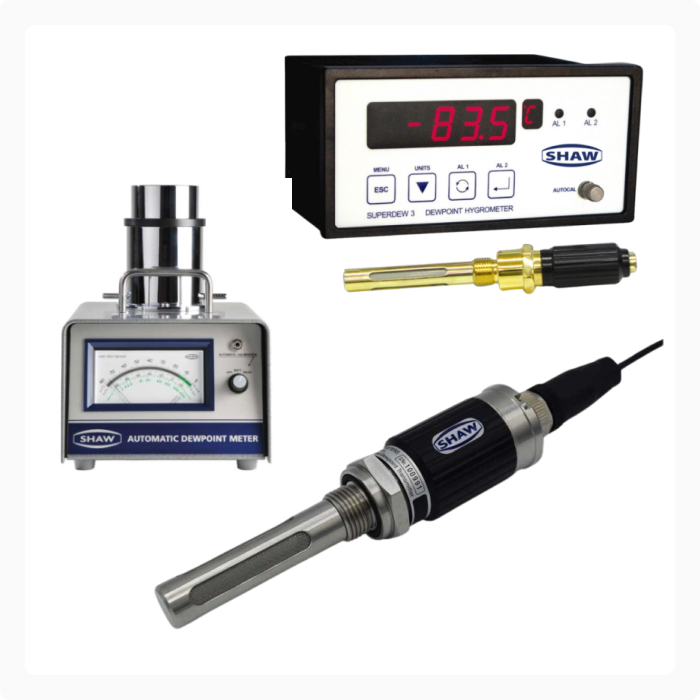
Therefore, dew point sensors are preferred in industrial and process applications where condensation presents a significant risk. Compressed air systems, natural gas pipelines, cleanrooms, pharmaceutical manufacturing, and cold chain logistics rely on dew point data to prevent issues such as pipeline corrosion, contamination, ice formation, and compliance failures, all of which can result in costs that exceed the price of the sensor.
Dew Point Sensor vs. Humidity Sensor: Side-by-Side Comparison
| Factor | Humidity Sensor (RH) | Dew Point Sensor |
| What it measures | Relative percentage of moisture vs. maximum capacity | The absolute temperature at which condensation begins |
| Affected by ambient temperature? | Yes, RH changes as temperature changes | No, dew point stays independent of ambient shifts |
| Common technology | Capacitive or resistive polymer sensors | Chilled mirror, polymer, or aluminum oxide sensors |
| Best for | General climate monitoring, comfort, HVAC | Industrial process control, condensation risk, gas/air quality |
| Typical industries | Agriculture, building management, storage, and museums | Compressed air, oil & gas, pharma, cleanrooms, food processing |
| Precision at extremes | Less reliable at very low or very high temperatures | Stays accurate across a wide dynamic range |
| Maintenance needs | Generally low, periodic recalibration | Varies by type; chilled mirror needs more frequent servicing |
| Common output | Percentage (%RH) | Temperature (°C or °F dew point) |
| Typical cost range | Lower upfront cost | Higher upfront cost, justified by process-critical accuracy |
Where Each Sensor Actually Shines
Humidity Sensors Work Best When:
- You’re monitoring indoor comfort levels or general climate conditions for people or storage
- Your process operates within a fairly stable, moderate temperature range
- You need a quick, cost-effective way to flag “too dry” or “too humid” conditions before they become a problem
- The application is agricultural, residential, or standard commercial HVAC
- You’re tracking conditions for product storage where mild fluctuations are acceptable, like warehousing or general retail environments
Dew Point Sensors Work Best When:
- Condensation itself is the failure point you’re trying to prevent, not just discomfort
- You’re working with compressed air or gas systems where moisture causes corrosion, freezing, or contamination downstream
- Your process spans a wide or fluctuating temperature range, where RH measurements would be misleading or simply inaccurate.
- You’re in a regulated environment (pharmaceutical manufacturing, food-grade gas, cleanroom production) where absolute moisture content needs to be documented and traceable for compliance.
- Your system operates at low temperatures or high pressures, conditions where standard RH sensors tend to lose accuracy fast.
Real-World Examples: Why the Distinction Matters
In a compressed-air system supplying a pneumatic assembly line, moisture condensation within the line can cause corrosion of internal components, damage to tooling, and product contamination. A humidity sensor reading ‘60% RH’ at the compressor outlet is not informative in this context, as the temperature within the line fluctuates due to air movement, compression, and expansion. The critical parameter is the dew point: if it exceeds the lowest temperature the air will encounter downstream, condensation will inevitably occur. A dew point sensor provides a direct, temperature-independent measurement relevant to this scenario.
In contrast, a seed storage warehouse aims to maintain air conditions that are neither excessively damp nor dry, preserving grain quality and minimizing temperature fluctuations. In this environment, a humidity sensor is sufficient and more cost-effective than an industrial-grade dew point instrument, since the primary risks are mold growth and spoilage rather than condensation in pipes.
Ultimately, the key consideration is not the sensor’s technological advancement, but the specific measurement question to be addressed.
Can You Use One Sensor for Both Jobs?
In general, a single sensor cannot reliably perform both functions. Because relative humidity is temperature-dependent while dew point is not, a standard RH sensor cannot accurately calculate dew point without precise, real-time temperature data at the measurement location. Some instruments integrate temperature and humidity sensors to estimate the dew point, which is adequate for general monitoring. However, for process-critical applications, a dedicated dew point sensor provides superior accuracy, particularly at low moisture levels where RH sensors often lose precision.
For applications requiring both readings, it is advisable to select a combined transmitter that measures dew point directly rather than deriving it mathematically from RH and temperature. Direct measurement eliminates calculation errors that can accumulate rapidly in sensitive industrial environments, especially those operating near freezing temperatures or under high pressure.
Common Mistakes When Choosing Between the Two
A few patterns show up again and again when teams get this wrong:
- Defaulting to “humidity” out of habit. Because relative humidity is the more commonly known term, procurement teams sometimes specify an RH sensor for an application that actually needs dew point measurement, simply because nobody stopped to ask which value the process control system actually depends on.
- Ignoring the temperature range at the measurement point. RH sensors are reasonably reliable within moderate, stable conditions, but their accuracy degrades noticeably at temperature extremes. If your system operates near freezing, in high heat, or under variable pressure, an RH reading alone can be misleading.
- Underestimating maintenance requirements. Chilled mirror dew point sensors deliver excellent accuracy, but they require more frequent cleaning and calibration than polymer-based sensors. Choosing the most accurate option without accounting for maintenance overhead can lead to instruments that drift out of spec faster than expected.
- Overlooking response time. In fast-changing processes, the sensor’s response time matters as much as its accuracy. Some dew point technologies respond more slowly to rapid changes in moisture than others, which can be problematic in dynamic industrial environments.
Which One Do You Need?
The primary consideration is whether the objective is to maintain comfort for occupants or products, or to prevent moisture from entering a system entirely.
If the goal is to maintain comfort or general climate conditions, a humidity sensor is effective and offers lower initial and ongoing costs. Conversely, in applications such as compressed air systems, gas systems, or processes where even minimal condensation can cause downstream damage, a dew point sensor is a safer and ultimately more cost-effective investment. The potential cost of a single failure or contamination event often exceeds the price difference between sensor types.
The location of the measurement within the system is also important. A sensor installed in an area with relatively constant temperature may function adequately with RH measurement alone. In contrast, locations subject to temperature fluctuations, near-freezing conditions, or pressure changes generally require dew point data for meaningful results.
Conclusion
Dew point sensors and humidity sensors both measure moisture, but they answer two fundamentally different questions. Relative humidity tells you how saturated the air is right now, at this specific temperature. Dew point indicates the exact threshold at which moisture will condense, regardless of what the temperature does next, making it a more reliable metric wherever temperature isn’t stable.
Selecting the appropriate sensor is not determined by perceived technological advancement or precision, but by aligning the instrument with the specific risks present in the application. Proper sensor selection safeguards equipment, product quality, and compliance records, while also preventing unnecessary expenditure on over-specified instruments.
For assistance in selecting the appropriate sensor for specific process conditions, JLC International’s flow and moisture measurement specialists can provide guidance on suitable solutions, including dew point transmitters, humidity probes, or combined systems tailored to the application’s requirements.