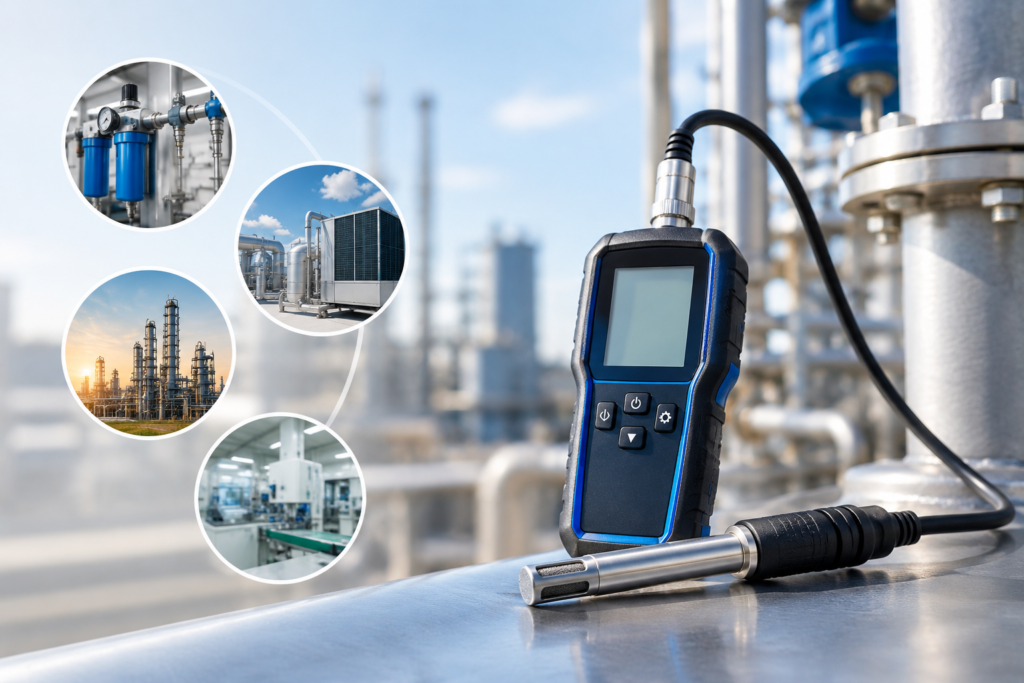
Humidity is one of those variables you can ignore until it ruins something. A batch of tablets that picks up moisture during compression. A paper roll that curls in storage. A server room where static discharge becomes a weekly annoyance. In each case, someone was probably measuring humidity. The question is whether they were measuring it well.
Industrial humidity sensors look simple on a datasheet. A probe, a transmitter, a 4- 20 mA output, an accuracy figure. But the gap between a sensor that reads correctly on day one and one that keeps reading correctly in a hot, dusty, chemically messy plant is wider than most spec sheets let on. This post walks through the three things that decide which side of that gap you land on: accuracy, calibration, and the application itself.
What Are You Actually Measuring?
Before comparing models, it helps to be clear on the quantity. Most industrial humidity sensors report relative humidity (%RH), which is the amount of water vapor in the air compared with the maximum the air can hold at that temperature. The catch is right there in the definition. Because relative humidity depends on temperature, a small temperature error becomes a humidity error.
Some processes care more about absolute moisture content, such as dew point, ppm by volume, or grams of water per cubic meter. Compressed air dryers and very dry gas applications are common examples, and in those cases a dew point instrument is often a better tool than a %RH sensor. If you’re deciding between the two, our earlier piece on dew point versus humidity sensors goes through that choice in more detail.
For the rest of this post, we’ll focus on %RH measurement, which covers most industrial use.
Common Sensing Technologies, Briefly
Most industrial humidity sensors you’ll meet fall into a few families.
Capacitive sensors are the workhorse. A thin polymer layer absorbs or releases water vapor as humidity changes, shifting the capacitance between two electrodes. They’re compact, respond quickly, and handle a wide range, which is why they show up in HVAC, cleanrooms, storage areas, and general process monitoring.
Resistive sensors measure how a hygroscopic material’s electrical resistance changes with moisture. They’re inexpensive and fairly robust, but they’re less accurate at the extremes and can drift more over time.
Thermal conductivity sensors compare the heat-conducting properties of humid and dry gas. They measure absolute humidity and tolerate high temperatures well, so they’re well-suited for ovens, dryers, and other harsh environments.
Chilled mirror and psychrometric instruments sit at the high-accuracy end. Chilled mirror devices often serve as reference standards, and psychrometers, which compare wet- and dry-bulb temperatures, remain common for spot checks. You typically wouldn’t install either permanently on a production line.
For continuous, in-process work, capacitive probes are the usual starting point. They aren’t perfect, but they offer the best balance of cost, speed, and accuracy for most plants.
Accuracy: Reading Past the Headline Number
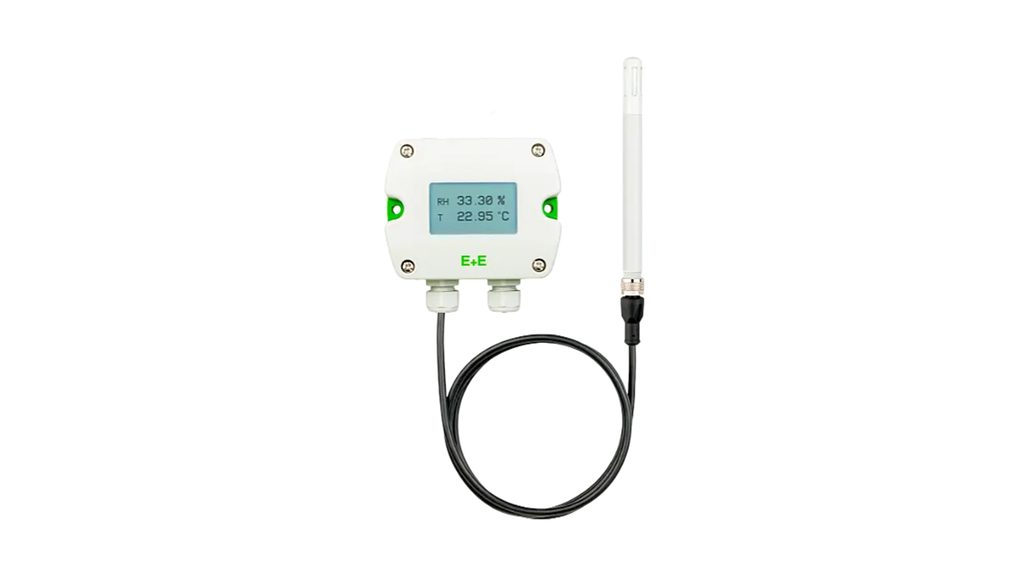
This is where doubt pays off. A datasheet might say ±2 % RH, and that sounds precise. But that figure usually comes with conditions attached, such as a specific temperature range, a specific humidity band, and a freshly calibrated sensor. Step outside those conditions and the real-world error can grow.
A few things sit behind the accuracy number and are worth checking.
Accuracy across the range. Many sensors are tighter in the middle of the scale, say 10 to 90 %RH, and looser below or above that. If your process lives at 3 %RH or 98 %RH, ask for the specification at that point, not the best-case figure.
Temperature dependence. Because relative humidity is tied to temperature, the sensor’s temperature coefficient matters. A probe that’s accurate at 25°C may read differently at 60°C. The best transmitters compensate for this internally, but it’s worth confirming.
Hysteresis. If a sensor reads one value while humidity is rising and a slightly different value while it’s falling, that gap is hysteresis. A typical figure for good capacitive sensors is around ±1 % RH, but it can be higher after exposure to extreme conditions.
Repeatability and long-term stability. Accuracy at purchase is only part of the story. Stability, often given as drift per year, tells you how far the sensor is likely to wander before it needs attention. A common figure for quality sensors is around 1% RH per year, though harsh environments can push it higher.
Response time. Some processes change fast, and others don’t. A slow-response sensor, especially one buried behind a heavy filter, can give you a perfectly accurate reading of conditions from a minute ago. For control loops, that lag matters.
The practical takeaway is simple. Don’t buy on the headline number alone. Ask what it means across your range, at your temperature, over your calibration interval.
Calibration: The Part People Skip
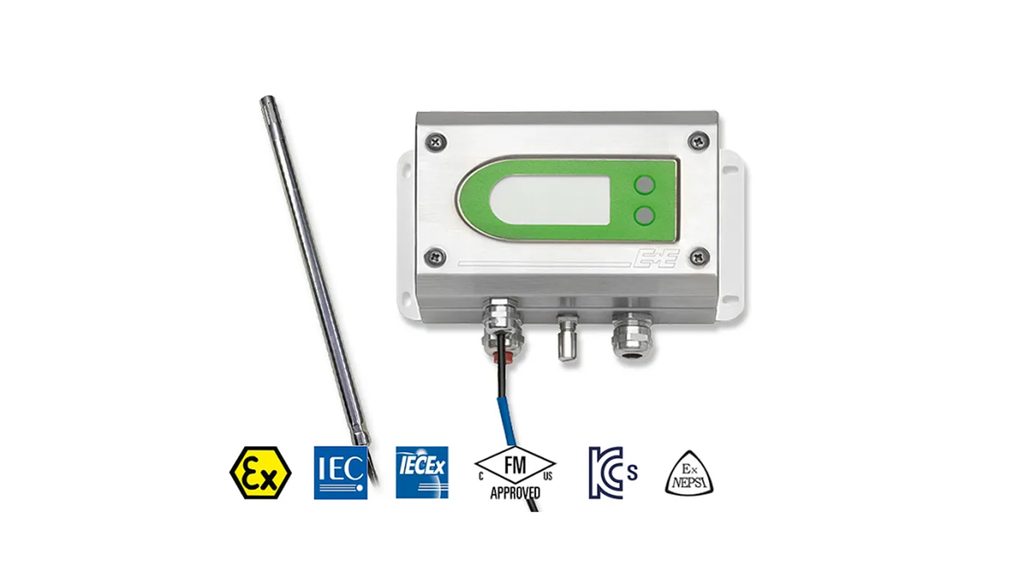
Every humidity sensor drifts. It’s not a defect; it’s just physics. Polymer layers age, contaminants build up, and extremes leave their mark. Calibration catches that drift before it affects your product or your records.
How calibration is usually done
There are a few common approaches.
Saturated salt solutions. A sealed container with a specific salt and water creates a known, stable humidity at a given temperature. Lithium chloride gives roughly 11% RH, magnesium chloride about 33% RH, sodium chloride around 75% RH, and potassium sulfate close to 97% RH. It’s inexpensive and works well for checks, but it requires patience, stable temperature, and careful handling.
Humidity generators and climatic chambers. These produce controlled conditions across a range and are faster and more flexible. They’re the usual choice for accredited laboratories.
Comparison against a reference instrument. You place a trusted, recently calibrated reference next to the sensor under test and compare readings in the same environment. This is often how field checks are done.
One point or multiple?
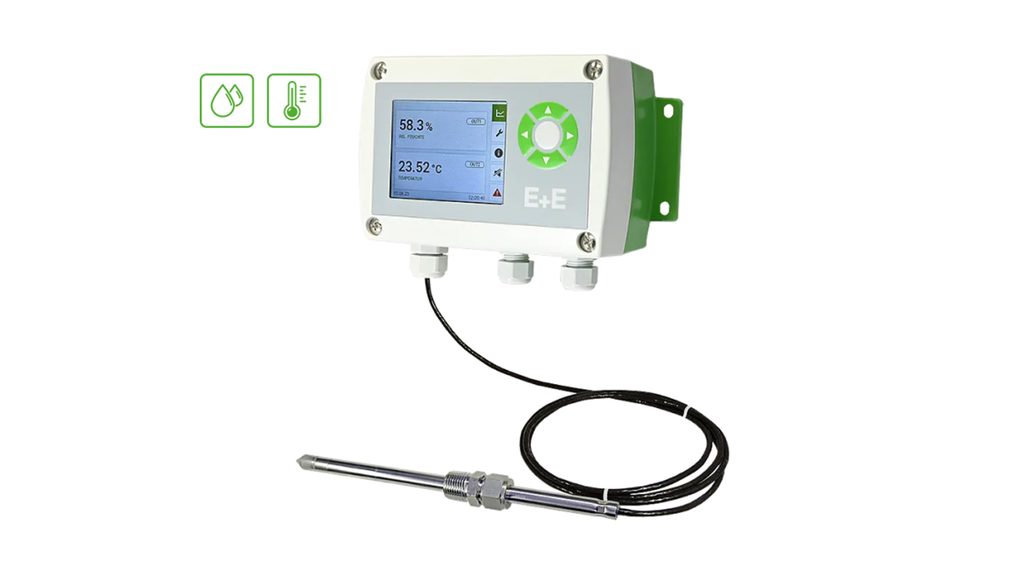
A single-point check can confirm the sensor is close at one humidity level, but it won’t show how it behaves elsewhere. A two-point or multi-point calibration, say at 33 and 75% RH, gives a much better picture and lets you adjust both offset and slope. If your process runs across a wide range, multi-point is worth the extra time.
How often?
There’s no single answer, but many plants calibrate or verify industrial humidity sensors every six to twelve months. In demanding environments, with high temperatures, chemical vapors, or heavy dust, a shorter interval makes sense. A good approach is to start with a conservative interval, track each sensor’s drift at every check, and then adjust. If a sensor consistently comes back within tolerance, you can stretch the schedule. If it doesn’t, tighten it.
Traceability and documentation
In regulated industries like pharmaceuticals, food, and medical manufacturing, calibration alone isn’t enough. You need records that trace back to national or international standards, ideally from a laboratory accredited to ISO/IEC 17025. Even in less regulated settings, keeping calibration certificates and as-found and as-left data makes troubleshooting much easier. When a process drifts, you’ll want to know whether the sensor caused it.
Application Considerations That Change Everything
You can buy an excellent sensor and still get poor results if it doesn’t suit the installation. A few application factors deserve attention before you commit.
Temperature and pressure. Standard probes have limits, and pushing past them shortens sensor life or causes errors. High-temperature applications, such as drying ovens, may require specialized probes with extended ranges. Pressurized lines need probes and fittings rated for the pressure.
Condensation. Capacitive sensors don’t love getting wet. Condensation can cause temporary errors or, if it happens repeatedly, long-term damage. Some probes are heated to stay above the dew point, which helps in environments close to saturation.
Chemical exposure. Solvents, cleaning agents, acids, and other vapors can contaminate or degrade the sensing layer. Cleanrooms that use sanitizing agents and solvent-based processes should prioritize chemical resistance and consider protective filters.
Dust, oil, and particulates. Filters protect the sensing element, but they also slow response and need replacing. In dirty environments, plan for both.
Placement. Where you mount the probe matters as much as which probe you buy. Avoid dead air, direct drafts from vents, heat sources, and spots near doors or moisture sources. A sensor mounted in an unrepresentative spot will give you an accurate reading of the wrong place.
Output and integration. Confirm the transmitter works with your control system, whether via 4-20 mA, voltage, Modbus, or another protocol. Also think about cable length, shielding, and whether you need local display, alarms, or data logging.
Where Industrial Humidity Sensors Earn Their Keep
Requirements shift by industry, so it helps to see how priorities change.
In pharmaceutical and cleanroom environments, accuracy, documentation, and calibration traceability come first. Small deviations can affect product quality and compliance.
In food processing and storage, humidity affects shelf life, texture, and mold growth. Washdown conditions and sanitizing agents make robust housings and chemical resistance important.
In paper, textile, and packaging plants, moisture content changes how materials behave on the line. Stable, repeatable readings tend to matter more than ultimate precision.
In HVAC and building management, cost and ease of installation often win out, with moderate accuracy requirements.
In data centers and electronics manufacturing, both low and high humidity create problems, from static discharge to corrosion, so the goal is reliable monitoring across a narrow band.
In drying and curing processes, high temperatures and fast-changing conditions call for sensors that can withstand heat and respond quickly.
Pulling It Together
If you’re selecting or replacing industrial humidity sensors, a simple checklist keeps the decision grounded:
- Define the range, temperature, and pressure the sensor will see in real operation.
- Look at accuracy across that range, not just the best-case figure.
- Check drift and plan a calibration interval you can actually keep.
- Match the probe, filter, and housing to the environment.
- Consider where it’s mounted and how the signal reaches your system.
Do those five things, and you’ll avoid most of the headaches people run into after installation.
Conculsion
Good measurement isn’t about buying the most expensive instrument. It’s about understanding what a number means, keeping it honest over time, and putting the right device in the right place. Industrial humidity sensors reward that attention, and they quietly punish its absence.
If you’re comparing options or unsure which technology fits your process, JLC International’s team can help you narrow it down based on your range, environment, and calibration requirements.